Blog

  • English Cocker Spaniel Colours: Solids, Parti-Colours and Roans Explained

    English Cocker Spaniel Colours: Solids, Parti-Colours and Roans Explained

    Updated November 2026. English Cocker Spaniel Guide is an independent site, not affiliated with any breed club or kennel club. Some links are affiliate links: as an Amazon Associate we earn from qualifying purchases.

    Few breeds come in as many attractive colours as the English Cocker Spaniel. Glossy black, rich golden and chocolate liver solids, crisp parti-colours, and the speckled roans that many people think of as the classic cocker look all belong to the same breed. This guide explains each colour group, the patterns within them, how colours can change as puppies grow, and what colour does and does not tell you about a dog.

    The three main colour groups

    English Cocker colours fall into three broad families: solid (self) colours, parti-colours and roans. Each can also come with tan markings. Breed standards describe these colours slightly differently in different countries, so if you plan to show, check the current standard of your kennel club.

    GroupWhat it looks likeExamples
    Solid (self) coloursOne colour all over; a small amount of white on the chest is generally tolerated in many standardsBlack, liver, red, golden
    Parti-coloursClearly defined patches of colour on a white backgroundBlack and white, liver and white, orange and white, lemon and white
    RoansColoured hairs evenly intermingled with white, giving a speckled or blended lookBlue roan, liver roan, orange roan, lemon roan
    With tanAny of the above with tan points on the eyebrows, muzzle, chest and legsBlack and tan, blue roan and tan, black, white and tan

    Solid colours

    Black

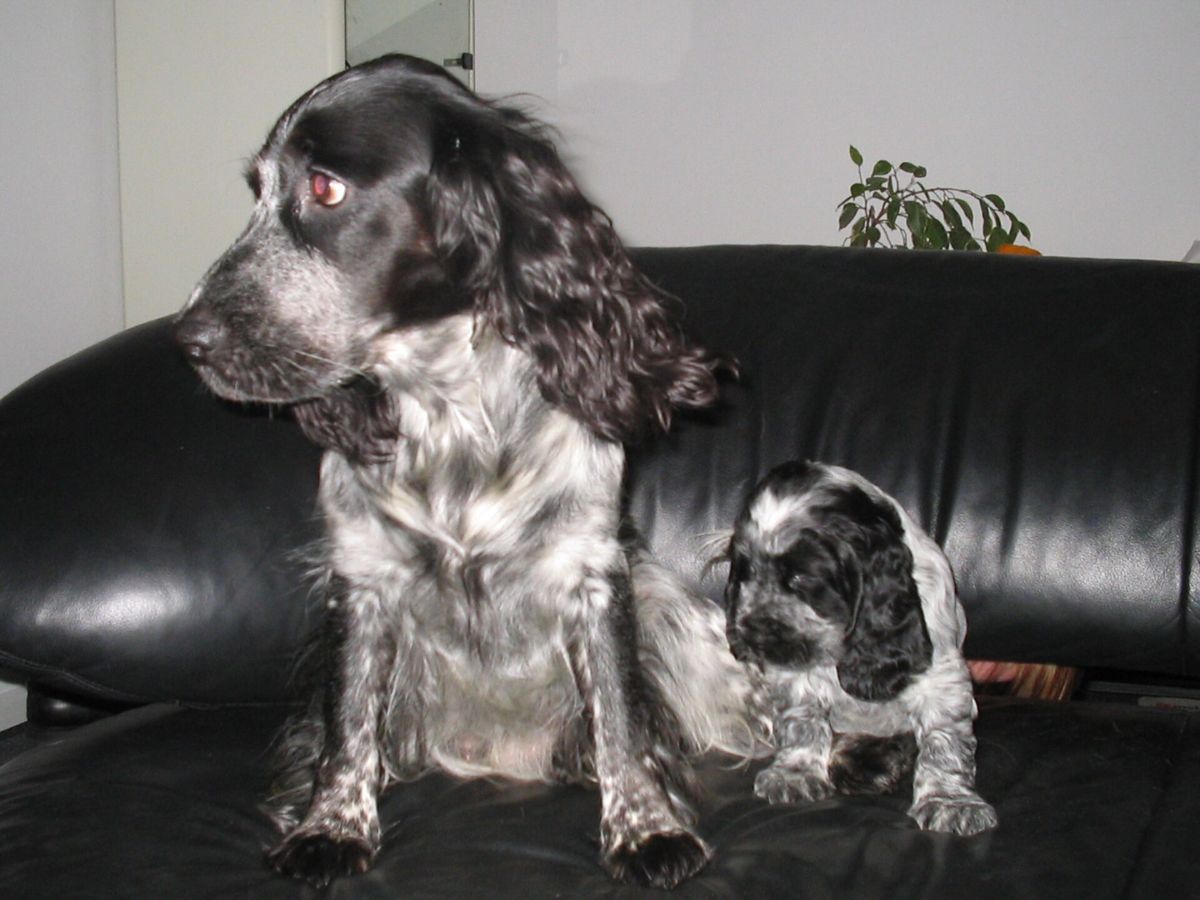
    Solid black English Cockers have a deep, glossy coat and are one of the most popular colours. They may show a little white on the chest.

    Golden and red

    Golden ranges from pale lemon through to deep red. Solid red and golden cockers are especially popular as family pets and are often what people picture when they think of a cocker spaniel. The shade can deepen or lighten with age and season.

    Liver

    Liver is the breed term for chocolate brown. Liver dogs have brown noses, lips and eye rims to match, and their eyes are often a lighter hazel.

    Black and tan, liver and tan

    Tan points appear in the same places as on a Dobermann: over the eyes, on the cheeks and muzzle, on the chest, on the legs and under the tail.
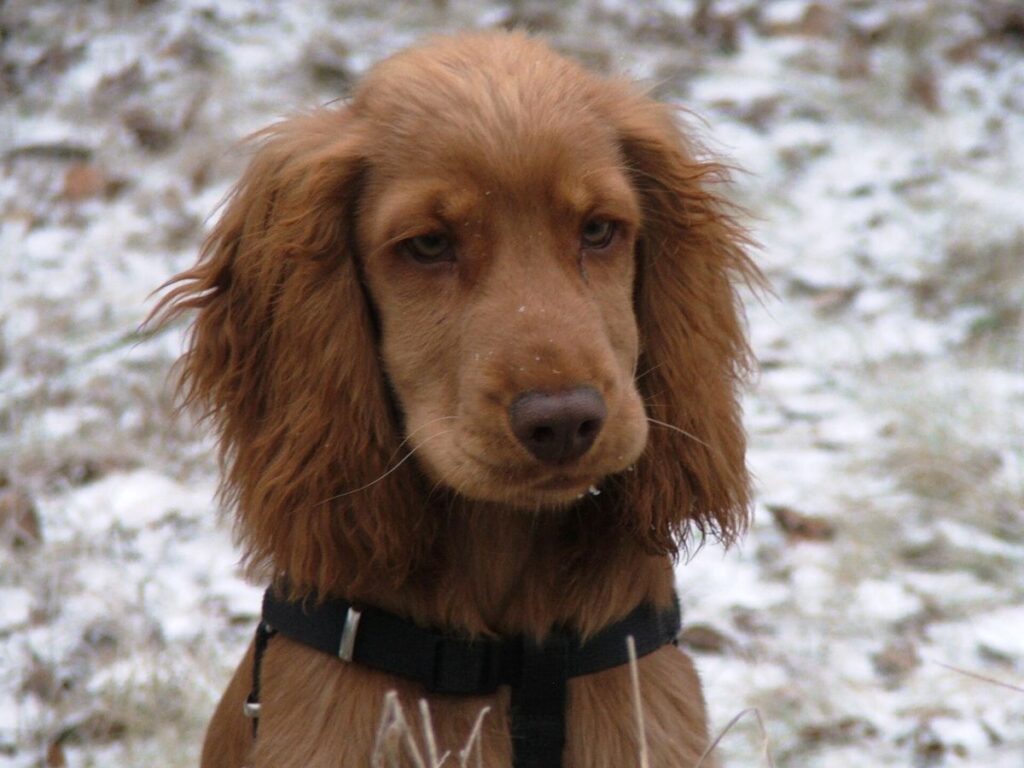
    A liver English Cocker Spaniel
    A liver English Cocker Spaniel. Photo: Michelangelo at Polish Wikipedia, via Wikimedia Commons, CC BY-SA 3.0

    Parti-colours

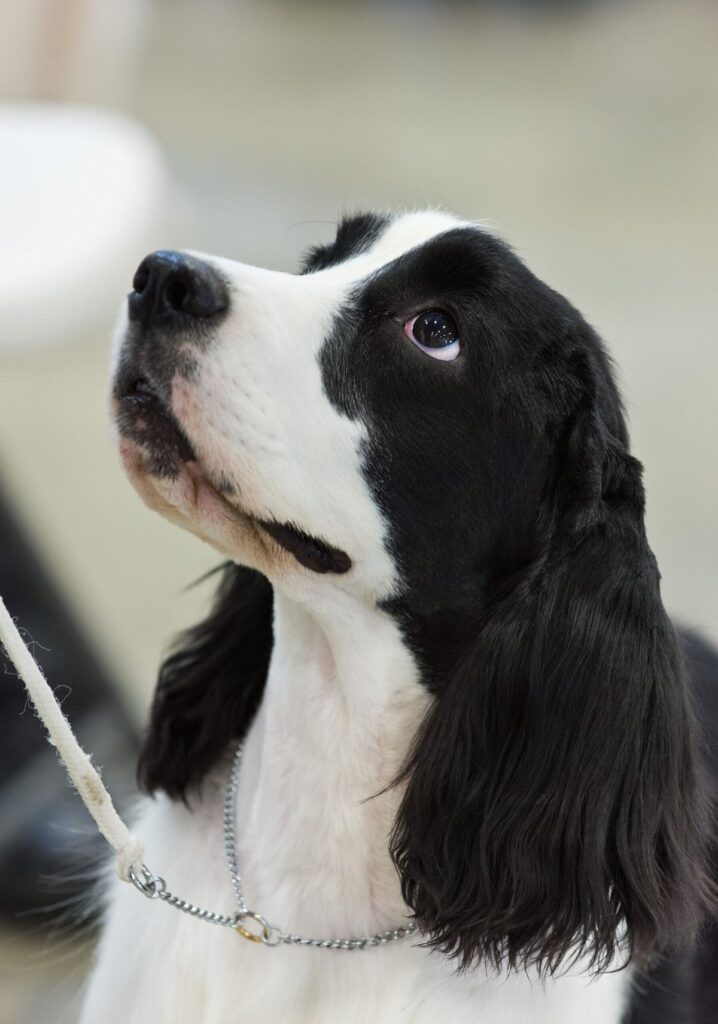
    Parti-colours have clear, distinct patches of colour on a white background. Black and white, liver and white, orange and white and lemon and white are all seen, and any of them can have tan markings, which makes a tricolour such as black, white and tan. The amount of white varies a great deal from dog to dog; some are mostly white with a few patches, others mostly coloured with white on the face and chest.

    Roans

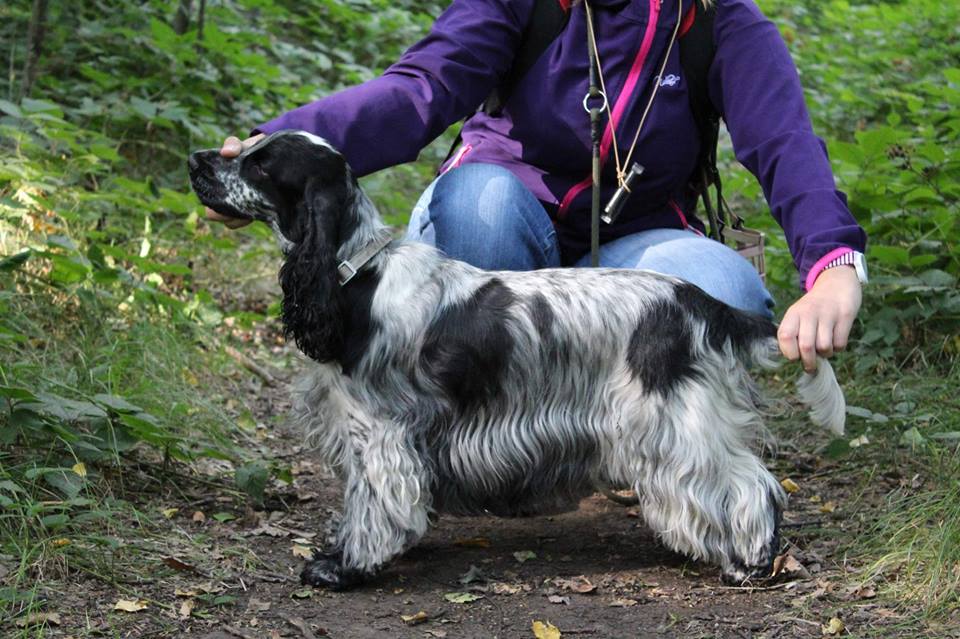
    Roans are the signature colour of the English Cocker. In a roan, coloured and white hairs are mixed together over the white areas of the coat, so the dog looks speckled or blended rather than patched. The roan colour is named after the base colour mixed with the white:

    • Blue roan: black mixed with white, giving a smoky blue-grey look.
    • Liver roan: brown mixed with white.
    • Orange roan: orange mixed with white.
    • Lemon roan: pale yellow mixed with white.
    • Roan and tan: any roan with tan points, for example blue roan and tan.

    Roan puppies are often born looking almost white with coloured patches, and the roaning appears and deepens over the first weeks and months. Many owners are surprised by how much a roan puppy changes as it grows.
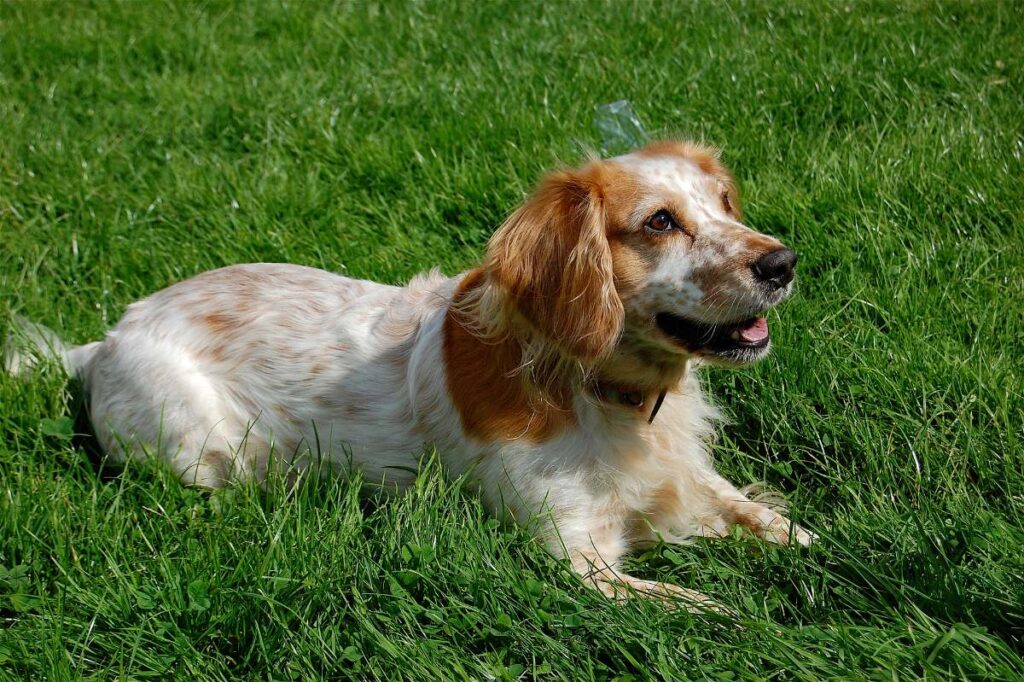
    An orange roan English Cocker Spaniel
    An orange roan English Cocker Spaniel. Photo: eNil, via Wikimedia Commons, CC BY 2.0
    A black and white English Cocker Spaniel
    A black and white English Cocker Spaniel. Photo: SheltieBoy, via Wikimedia Commons, CC BY 2.0

    Do colours change as puppies grow?

    Yes, often. Roaning develops over the first months, golden puppies can darken or lighten, and coats can look different after the puppy coat is replaced by the adult coat. Clipping can also make a coat look lighter or darker, because the undercoat may be a different shade from the longer feathering. Ask the breeder what the parents looked like as puppies and as adults if you want an idea of how a puppy may turn out.

    Does colour affect temperament or health?

    There is a lot of folklore about cocker colours, including the long-standing claim that solid-coloured cockers are more prone to behaviour problems than parti-colours. Studies have reported differences between colour groups, but temperament depends far more on breeding, early socialisation and training than on colour. Choose a puppy based on the health and temperament of the parents, not on coat colour alone.

    One genuine colour-related issue is deafness. As in many breeds, congenital deafness is linked to extensive white in the coat, so many breeders of parti-colours and roans have puppies hearing-tested (BAER tested). Ask about this if you are buying a puppy with a lot of white. See our health guide for other recommended tests.

    Grooming different colours

    Colour makes little difference to grooming, but a few practical points help. Dark coats can fade or turn reddish in strong sun; light coats show tear stains and mud more; roans can look patchy straight after clipping until the coat grows back. A good brush and comb and regular trims keep any colour looking its best. Our grooming guide explains the full routine.

    English Cocker colours vs American Cocker colours

    American Cocker Spaniels are grouped differently, into black, ASCOB (any solid colour other than black) and parti-colours, and roans are far less common in the breed. If you are trying to tell the two breeds apart, head shape and size are more reliable clues than colour. See English vs American Cocker Spaniel.

    Frequently asked questions

    What is the most common English Cocker colour?

    Solid golden or red, solid black and blue roan are among the colours seen most often, though popularity varies by country and by show or working lines.

    What is a blue roan cocker spaniel?

    A dog with black and white hairs mixed together over the white areas of the coat, which looks blue-grey from a distance. Many blue roans also have tan markings.

    Is a tricolour cocker spaniel rare?

    No. Tricolours, such as black, white and tan, are a recognised and fairly common colour combination.

    Should I choose a puppy by colour?

    Colour is a fine way to choose between equally healthy, well-bred puppies, but health testing and the temperament of the parents matter far more.

    Featured photo: M.Minderhoud, via Wikimedia Commons, CC BY-SA 3.0
  • English Cocker Spaniel vs American Cocker Spaniel: What’s the Difference?

    English Cocker Spaniel vs American Cocker Spaniel: What’s the Difference?

    Updated November 2026. English Cocker Spaniel Guide is an independent site, not affiliated with any breed club or kennel club. Some links are affiliate links: as an Amazon Associate we earn from qualifying purchases.

    English Cocker Spaniels and American Cocker Spaniels share a name, a common ancestry and a famously affectionate nature, so it is no surprise that people mix them up. In North America they are two separate breeds, each with its own breed standard, and the differences go well beyond looks. If you are deciding which one suits your home, or trying to work out which one you already have, this guide sets out how they compare.

    A shared history, then two paths

    Both breeds descend from the small flushing spaniels used in Britain to find and flush woodcock and other game. In the late 1800s, spaniels were divided by size, and the smaller ones became known as cockers. Cockers taken to North America were gradually bred toward a smaller, rounder-headed dog with a more profuse coat, and that line became the American Cocker Spaniel. Breeders who wanted to preserve the original British type kept the two apart, and the American Kennel Club recognised the English Cocker Spaniel as a separate breed in 1946.

    In the United Kingdom and most of the world, the English dog is simply called the “Cocker Spaniel”, while the North American dog is the “American Cocker Spaniel”. That is why British and European books and breeders rarely use the word “English” at all.

    At a glance

    English Cocker SpanielAmerican Cocker Spaniel
    Height (AKC standard)Males about 16 to 17 in; females about 15 to 16 inMales about 15 in; females about 14 in
    Typical weightAbout 26 to 34 lbAbout 20 to 30 lb
    HeadLonger muzzle, flatter skull, moderate stopShorter muzzle, rounded domed skull, pronounced stop
    CoatSilky, moderate featheringProfuse, longer feathering, especially in show dogs
    BuildAthletic, compact sporting dogSmaller, more compact, sloping topline
    Common coloursSolids, parti-colours and roansBlack, ASCOB (any solid colour other than black) and parti-colours
    GroomingModerateHigh, especially for a full coat

    Breed standards set out ideals; individual dogs vary, and working-bred English Cockers are often lighter and leggier than show-bred dogs.

    Head and expression

    The head is usually the quickest way to tell the breeds apart. The English Cocker has a longer, squarer muzzle and a flatter skull, with a gentle slope from forehead to nose. The American Cocker has a shorter muzzle, a domed skull and a more pronounced stop, which gives it a rounder, more baby-like face and larger-looking eyes. Both breeds should have a soft, melting expression.

    Body and movement

    The English Cocker is a sporting dog built to work through cover all day. It stands a little taller, with more leg under it, and moves with drive. The American Cocker is smaller and more compact, often with a sloping topline in the show ring. Both should be sound, balanced movers, but the English dog tends to look more like a small field spaniel and the American more like an elegant companion.

    A parti-colour American Cocker Spaniel
    A parti-colour American Cocker Spaniel. Photo: ItsWolfeh, via Wikimedia Commons, CC BY-SA 3.0

    Coat, colours and grooming

    Both breeds have silky, medium-length coats with feathering on the ears, chest, belly and legs. The American Cocker’s show coat is far more profuse and needs regular professional grooming to keep it from matting, while the English Cocker’s coat is more moderate. Pet owners of either breed often keep a shorter, practical trim.

    Colours differ too. Roan coats, such as blue roan and orange roan, are a classic English Cocker look, alongside solids like black, liver and red, and parti-colours. American Cockers are grouped into black, ASCOB (any solid colour other than black, including buff and chocolate) and parti-colours. See our full guide to English Cocker Spaniel coat colours.

    Temperament and energy

    Both are affectionate, people-focused dogs that do best as part of family life. The English Cocker is often described as merrier and more active, and it usually keeps more of its hunting instinct: it loves to use its nose, carry things and work alongside its people. The American Cocker is generally a little calmer and is more often kept purely as a companion. Individual temperament depends heavily on breeding, socialisation and training, so meet the parents whenever you can. Our guide to English Cocker temperament goes into more detail.

    Exercise needs

    An English Cocker typically needs at least an hour of exercise a day, including off-lead running where it is safe and some sniffing and retrieving games. Working-bred lines can need even more. American Cockers need daily walks and play too, but usually a bit less. Neither breed is a couch potato, and both can become bored and noisy without enough to do. See how much exercise an English Cocker needs.

    A red American Cocker Spaniel
    A red American Cocker Spaniel. Photo: AKS.9955, via Wikimedia Commons, CC BY-SA 3.0

    Health

    The two breeds share some concerns, especially ear infections from their long, heavy ears, and inherited eye conditions. English Cocker breeders commonly screen for progressive retinal atrophy (PRA), familial nephropathy, adult-onset neuropathy and hip dysplasia, as well as eye examinations. American Cocker breeders screen for their breed’s own list of conditions. Always ask a breeder for health test results on both parents. Our English Cocker health guide explains the main tests.

    Which breed is right for you?

    • Choose an English Cocker if you want an active, outdoorsy companion that enjoys long walks, training and games, and you like a more natural, moderate look.
    • Choose an American Cocker if you want a smaller, slightly calmer companion and are happy to keep up with more grooming.
    • Either way, choose a responsible breeder or a reputable rescue; see our guides to finding a breeder and rescue and adoption.

    Frequently asked questions

    Is an English Cocker Spaniel the same as a Cocker Spaniel?

    Outside North America, yes: “Cocker Spaniel” means the English Cocker. In Canada and the United States, “Cocker Spaniel” usually means the American breed, so the word “English” is added to tell them apart.

    Which is bigger, the English or American Cocker?

    The English Cocker is generally taller and a little heavier, with more leg and a longer muzzle.

    Can the two breeds be registered together?

    No. They are registered as separate breeds with their own standards in North America.

    Which breed is easier to groom?

    The English Cocker, in most cases. Its coat is more moderate, though it still needs regular brushing and ear care.

    Featured photo: Vaneska88, via Wikimedia Commons, CC BY-SA 4.0